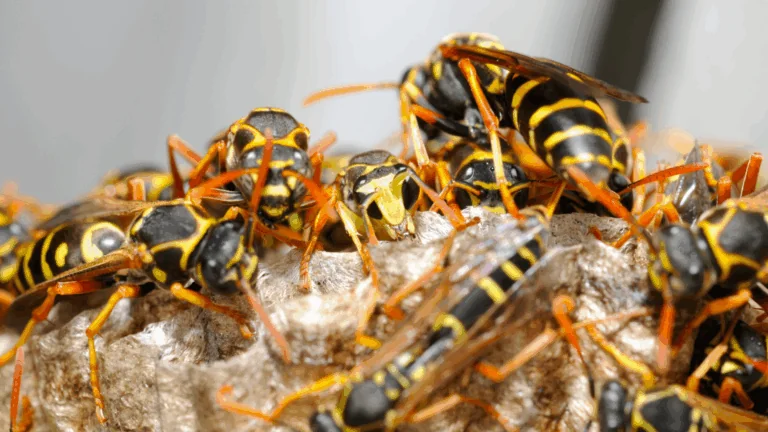
Wasp nest removal Surrey BC is one of the most common calls we get every summer. Found a wasp nest on your property? In Surrey BC, wasp season runs from May through October — and colonies grow fast. A nest that’s the size of a golf ball in June can be the size of a basketball by August, housing thousands of aggressive wasps. This guide tells you where nests hide, when to call a professional, and exactly what to expect from wasp nest removal Surrey BC.
Before attempting to remove a wasp nest yourself: only approach small, visible paper wasp nests with fewer than 10 wasps, and only at night when they’re inactive. Never spray a nest inside a wall, a ground nest, or anything larger than a grapefruit — these situations trap or provoke thousands of wasps and are best left to a professional, especially if anyone in the home has a wasp allergy.
When is wasp season in Surrey BC?
Wasp season in Surrey follows a predictable pattern — and 2026 started early due to BC’s warm spring:
- March–April: Queen wasps emerge from hibernation and begin building small starter nests, often the size of a walnut
- May–June: Colonies establish and grow rapidly — the best time to remove nests before they become dangerous
- July–August: Peak colony size. Nests can contain 1,000–5,000 wasps. Wasps are most aggressive at this stage
- September–October: Colonies begin dying off as queens stop laying. Wasps become erratic and more likely to sting as food sources dry up
- November onwards: Colony dies. Old nests won’t be reused next year — but queens overwinter nearby and return to the same areas
The best time to remove a wasp nest in Surrey is as soon as you find it — especially in May or June when nests are small and colonies are less defensive. Waiting until August means dealing with a much larger, more dangerous colony.
Where do wasps build nests in Surrey homes?
Surrey’s mix of mature trees, wood fences, garden sheds, and older siding gives wasps plenty of nesting options. The most common locations our technicians find:
- Eaves and roof overhangs — the most common location, sheltered from rain and facing south for warmth
- Inside wall cavities — wasps enter through small gaps in siding and build inside the wall void; these are the hardest and most dangerous to remove
- Garden sheds and garages — dark, undisturbed spaces with easy entry
- Underground (ground nests) — yellowjackets commonly build underground in gardens, lawns, and under patio stones
- Attics and soffits — often go unnoticed until the colony is very large
- Hedges, shrubs, and trees — paper wasps build open, umbrella-shaped nests in vegetation
- Decks and fences — especially in gaps between boards or under deck ledges
Wasps vs hornets vs yellow jackets — what’s on your Surrey property?
| Species | Appearance | Nest type | Aggression level |
|---|---|---|---|
| Yellow jacket | Bright yellow & black, small | Paper nest underground or in walls | Very high — sting repeatedly |
| Bald-faced hornet | Black & white, larger | Large grey paper nest in trees/eaves | Extremely high near nest |
| Paper wasp | Slender, reddish-brown | Open umbrella-shaped nest, visible cells | Moderate — defensive if nest disturbed |
| Mud dauber | Long, slender, black | Small mud tubes on walls | Low — rarely stings |
Yellow jackets and bald-faced hornets are responsible for the vast majority of sting incidents in Surrey. Both species will chase perceived threats and sting multiple times. If you can’t identify the species, assume it’s aggressive and call a professional.
Is it an Asian giant hornet (“murder hornet”)?
The Asian giant hornet, nicknamed the “murder hornet” in media coverage, was first detected on the BC/Washington border in 2019–2021 and has not been confirmed established in the Lower Mainland since. It’s significantly larger than anything in the table above — around 4-5 cm long with a distinctive orange-yellow head — and nests are typically underground, not in eaves or walls like the wasps most Surrey homeowners encounter. If you find a large flying insect you genuinely can’t match to yellow jackets, bald-faced hornets, or paper wasps above, don’t attempt to treat it yourself — take a photo from a safe distance, contact us for identification, and we’ll advise on next steps.
Should I remove a wasp nest myself?
For small, accessible paper wasp nests with fewer than 10 wasps, a hardware store wasp spray applied at night (when wasps are inactive) can work. But there are several situations where DIY is genuinely dangerous:
- Large nests (bigger than a grapefruit) — contain hundreds to thousands of wasps that will swarm if disturbed
- Nests inside walls or soffits — spraying the entrance traps wasps inside, forcing them to chew through interior drywall to escape into your home
- Ground nests — yellowjackets in the ground respond to vibration and can emerge in seconds; mowing over a ground nest is one of the most common causes of serious sting attacks
- Nests near doors, play areas, or high-traffic zones — risk of accidental disturbance is too high
- Anyone with a wasp allergy — anaphylaxis can set in within minutes; never attempt removal without an EpiPen on hand
The BC ambulance service attends hundreds of wasp sting calls every summer. If you’re not 100% certain of what you’re dealing with and how to approach it, call a professional.
What does professional wasp nest removal involve?
When Top Line attends wasp nest removal Surrey BC, here’s what happens:
- Assessment. We identify the species, locate the full extent of the nest, and determine the safest removal approach. Some nests require treating from a distance before approaching.
- Treatment. We apply professional-grade insecticide directly to the nest using equipment that reaches eaves, roof lines, and confined spaces safely. For ground nests, we treat the entrance and surrounding area.
- Nest removal. Once the colony is neutralised, we remove the nest where safely accessible. For nests inside walls or high rooflines, we may advise leaving the treated nest in place and sealing the entry point.
- Prevention advice. We’ll show you where wasps are likely to return next season and what to seal or treat proactively.
Most Surrey wasp nest removals take 20–40 minutes. You can remain on your property and return to normal activity within a couple of hours.
How much does wasp nest removal cost in Surrey BC?
Top Line charges $175–$300 for wasp nest removal Surrey BC, depending on nest size, location, and accessibility. Most standard eave or garden nests fall at the lower end. Nests inside walls, attics, or requiring ladder access cost more. We give you a firm price before we start — no surprises.
Get a free wasp nest removal quote here or call (604) 551-6504 for same-day service.
How to stop wasps from coming back next year
- Seal entry points — gaps in siding, soffits, and fascia boards are where wasps enter to build inside walls. Seal them in winter when wasps are inactive
- Remove old nests in autumn — while wasps won’t reuse the same nest, removing it discourages queens from nesting in the same area
- Keep lids on bins — wasps in late summer are attracted to sweet smells from garbage and compost
- Trim vegetation — dense hedges, overgrown shrubs, and tree branches touching your roofline are prime nesting sites
- Book an early-season check — catching a walnut-sized queen nest in April costs a fraction of removing a basketball-sized colony in August
Book Same-Day Wasp Nest Removal Surrey BC
Top Line Pest Control is owner-operated and based in Surrey. We offer same-day wasp nest removal Surrey BC across all Surrey neighbourhoods — Newton, Fleetwood, Cloverdale, South Surrey, Guildford, Whalley, Fraser Heights — as well as Langley, Abbotsford, and the Lower Mainland.
📞 (604) 551-6504 | Free quote online | See our wasp control service page
Why Homeowners Choose Our Wasp Nest Removal Surrey BC
Choosing wasp nest removal Surrey BC from a local, owner-operated company means faster response and technicians who already know where Surrey wasps tend to nest. Every wasp nest removal Surrey BC visit includes a full assessment, safe treatment, and prevention advice — not just a quick spray and an invoice.
We stand behind every wasp nest removal Surrey BC job with a firm, upfront price, so you know the cost before we start. Whether the nest is under your eaves, in a shed, or underground in the lawn, our wasp nest removal Surrey BC technicians carry the right equipment to handle it safely, the same day you call.
Frequently asked questions — wasp nest removal Surrey BC
How do I know if a wasp nest is active?
Look for wasps flying in and out of a single entry point in a regular pattern. Active nests have constant traffic during daylight hours. If you see no movement for several days in cool weather, the colony may have died off naturally for the season.
What time of day is safest to approach a wasp nest?
Wasps are least active just after dusk and before dawn when temperatures are cooler. If you need to observe a nest to identify it, do so briefly from a distance in the early morning. Never approach at midday during peak summer heat — colonies are most active and aggressive.
Will wasps return to the same spot next year?
Wasps don’t reuse old nests, but new queens emerging the following spring are attracted to the same sheltered spots. If you had a nest under the eaves this year, you’re likely to see another there next spring unless you seal entry points and remove the old nest.
I have a wasp nest inside my wall — is that dangerous?
Yes — this is one of the most serious wasp situations. Do not spray the entrance yourself. Blocking the entry forces thousands of wasps to find another exit, often through gaps into your living space. Call a professional who can treat from the outside correctly and advise on whether the entry point needs to be sealed immediately or after treatment.
Can I leave a wasp nest alone if it’s not near my door?
A nest in a remote corner of your garden may not need immediate removal if it’s well away from foot traffic. However, by August a small colony becomes a large one, and late-season wasps become increasingly aggressive as the colony dies off. Most Surrey homeowners find it worth removing any nest within 10–15 metres of a regularly used area.
Finding Wasp Nests Removal Near Me in Surrey
When searching for wasp nests removal near me, look for a licensed local exterminator who offers same-day service — wasp colonies grow fast, and delays let a golf-ball-sized nest become a basketball-sized one within weeks. Top Line Pest Control provides same-day wasp nests removal near me searches turn up across Surrey, Langley, and the wider Fraser Valley, with technicians who know exactly where local wasp species tend to nest.