
In the Lower Mainland, carpet beetles are a biological constant. While many residents in Surrey focus on high-profile pests like bed bugs, the carpet beetle remains the most frequent cause of “invisible” household scavenger activity and skin irritation. To identify them, you must understand that you are not looking for a single insect, but a species that undergoes a complete transformation.
The beetle on the window is the reproductive scout; the “woolly bear” in the floorboards is the scavenger. This guide provides the technical markers needed to identify every life stage and locate the environmental sources of an infestation.
What Does a Carpet Beetle Look Like?
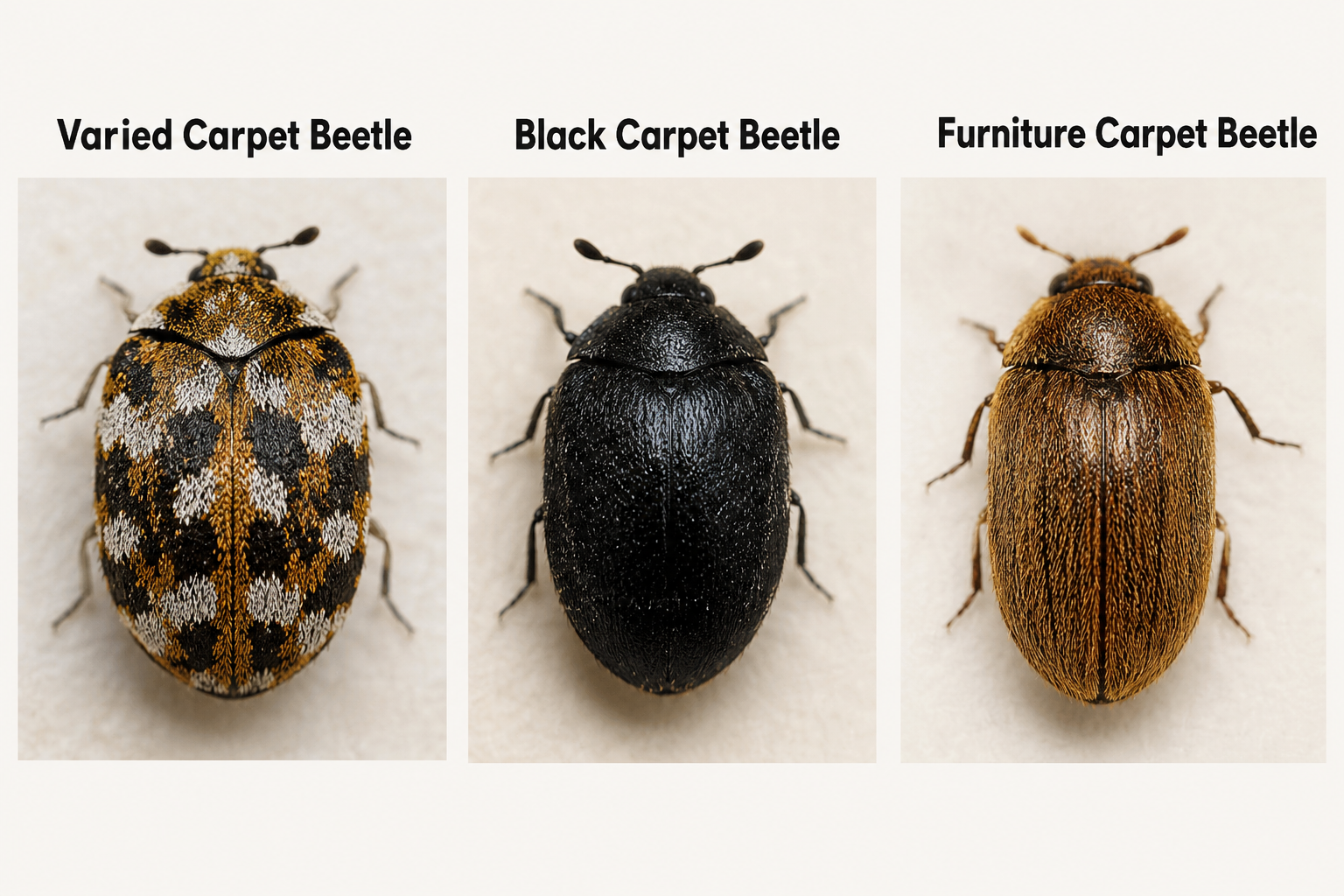
Adult carpet beetles are the most visible stage of the life cycle. In the pest control world, we refer to them as “window watchers” because of their innate attraction to sunlight and light fixtures. Identifying the specific species in your Surrey home helps determine the likely source of the larvae.
- Varied Carpet Beetle (Anthrenus verbasci): This is the most prevalent species across British Columbia. They measure 2mm to 3mm long and possess a round, bulbous body. Their most striking feature is a shell covered in tiny, overlapping scales that form a mottled, “camo” pattern of white, yellow, and brown. Under a magnifying glass, these scales look like irregular zig-zagged bands. As the beetle reaches the end of its life, these scales often rub off, revealing a solid, dark, shiny undershell that can lead to misidentification as a common black beetle.
- Black Carpet Beetle (Attagenus unicolor): Commonly found in older Surrey residences and kitchen pantries, these are more elongated and oval-shaped, measuring 3mm to 5mm. They feature a solid, shiny black or very dark brown shell with dark brown legs. Unlike the Varied species, they do not have mottled scales. They are strong fliers and are often found near ceiling light fixtures or attic hatches.
- Furniture Carpet Beetle (Anthrenus flavipes): These are slightly larger and rounder than the Varied type. Their shells show a distinct “checkerboard” pattern of white, yellow, and black. While they look similar to the Varied type, their underside is covered in white scales, and their legs have a distinct brownish-red tint. As the name suggests, they are heavily associated with upholstered items containing natural fibers.
What Do Carpet Beetle Larvae Look Like?
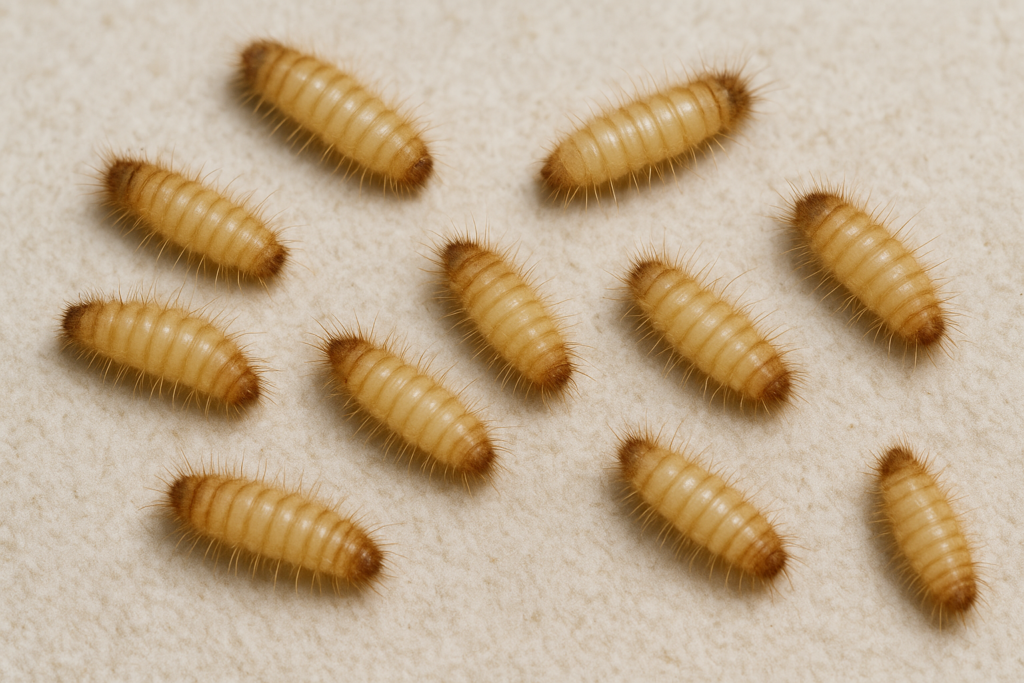
The larval stage is the engine of the infestation. Known as “woolly bears,” these are the only stage that consumes organic matter. They look nothing like the adult beetles and are frequently mistaken for different pests.
- Body Shape and Segmentation: Larvae have a distinct tapered, carrot-like shape—broadest at the head and narrowing significantly toward the rear. Their bodies are divided into visible horizontal segments, creating a ribbed or banded appearance along their back.
- Coloration: They are typically golden-brown, tan, or reddish-brown. The bands between their segments are often a darker chocolate brown, which becomes more pronounced as they grow.
- The Bristles (Hastisetae): Their bodies are covered in dense, stiff, dark hairs. These bristles are not uniform; they are often concentrated in tufts toward the rear. These hairs are a defense mechanism that causes “carpet beetle dermatitis,” a red, itchy rash often mistaken for bed bug bites.
- Physical Size: Mature larvae reach 4mm to 5mm in length. Because they are larger and more active than the adults, they are often the first physical evidence homeowners find during a deep clean.
- Shed Skins (Exuviae): As larvae grow, they molt, leaving behind translucent, hollow, light-brown husks. These “ghost” shells maintain the exact shape and bristly texture of the live larva. Because they are sticky and lightweight, they often get caught in spider webs, carpet pile, or the “felt” of dust bunnies.
- Movement & Light Sensitivity: Larvae are photophobic (light-avoiding). They do not stay in the open. If you shine a flashlight into a dark crevice, they will scurry with surprising speed toward the nearest shadow. This rapid, darting movement distinguishes them from the slower, more rhythmic crawling of moth larvae.
What Do Carpet Beetle Eggs Look Like?
The egg is the “stealth” stage. In a Surrey home, eggs are the reason a problem seems to disappear after a surface cleaning, only to return weeks later. They are rarely seen without magnification but are the key to a persistent infestation.
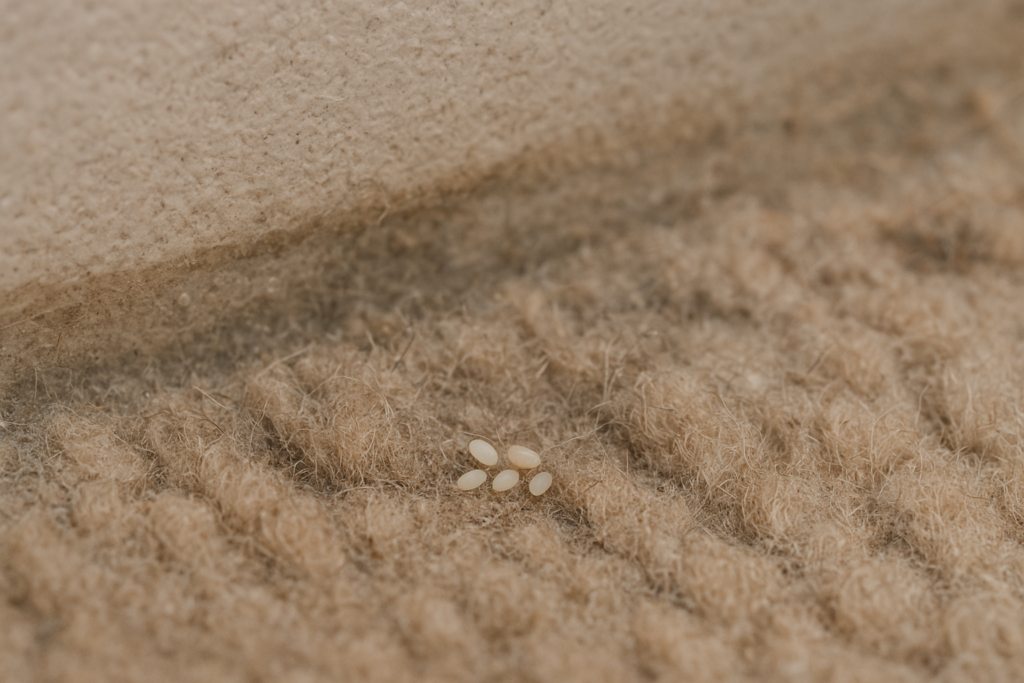
- Visual Markers: Eggs are pearly white or cream-colored ovals. They have a matte, non-reflective surface that makes them blend in with dust or lint specks.
- Dimensions: They are microscopic, measuring less than 1mm in length. They are roughly the size and shape of a single grain of fine salt.
- Surface Texture: One end of the egg features tiny, spine-like projections. These spines act as anchors, allowing the eggs to hook into the fibers of carpets, wool insulation, or the accumulation of pet hair in floor vents. This prevents them from being easily dislodged by a vacuum cleaner.
- Placement: Females deposit eggs in dark, undisturbed “high-protein” environments. Common sites in BC include the accumulation of dead insects in window tracks, the matting of pet hair behind baseboards, or inside the “dust traps” within forced-air heating ducts. A single female can deposit 40 to 100 eggs in a single cluster.
Differences Between Carpet Beetle And Carpet Beetle Larvae
Understanding the distinction between these two life stages is vital for choosing the right treatment. While they are the same species, they occupy completely different niches in your home.
Physical Shape and Texture
The adult carpet beetle is a hard-shelled, winged insect. It has a rigid exterior designed for flight and protection. In contrast, the larva is soft-bodied and fuzzy. It lacks wings and relies on its dense bristles for protection. If you find a “crunchy” bug, it is likely an adult; if it is soft, flexible, and “hairy,” it is a larva.
Environmental Preference
Adults are photophilic (attracted to light). They are almost exclusively found on windowsills, curtains, and near lamps as they attempt to fly toward the sun to find mates. Larvae are photophobic (avoid light) and thrive in total darkness. If you find a specimen under a baseboard, inside a floor vent, or behind heavy furniture, it is almost certainly the larval stage.
Diet and Impact
Adult carpet beetles are technically harmless to your property; they feed on pollen and nectar and often enter Surrey homes on fresh-cut flowers. The larvae are the scavengers. While the adult on your window is a nuisance and a sign of an infestation, the “woolly bear” larva in your floorboards is the one responsible for the degradation of your natural fiber rugs, clothing, and accumulated organic debris.
Carpet Beetle vs Carpet Beetle Larvae Comparison Table
| Feature | Adult Beetle | Larva (Woolly Bear) |
| Shape | Round/Oval, rigid shell | Carrot-shaped, soft body |
| Size | 2mm – 5mm (varies by species) | 4mm – 5mm (larger than adult) |
| Covering | Mottled scales or shiny black | Dense, stiff, irritating bristles |
| Movement | Flies or crawls toward light | Scurries away from light |
| Location | Windowsills, light fixtures | Baseboards, vents, rug undersides |
What Can Be Confused With a Carpet Beetle?
In the Lower Mainland, adult carpet beetles are frequently misidentified because they share the same “neighborhoods” as other common pests. The confusion usually stems from their size, where they hang out, or the panic of seeing a small, round insect.
- Bed Bugs: The confusion here is driven by fear and location. Both pests are small, brownish, and oval. When a Surrey resident finds a small beetle on their headboard or curtain, their mind immediately jumps to bed bugs. However, the “why” behind the confusion is often the physical reaction; both cause red, itchy skin marks—one from a bite, the other from larval hairs.
- Ladybugs (Lady Beetles): This is a morphological confusion. Both have a high-domed, round “shield” shape. Because Varied Carpet Beetles have yellow and white patterns, they are often mistaken for a “weird-colored” ladybug. Homeowners often ignore them, thinking they are beneficial garden visitors, not realizing these “tiny ladybugs” are actually the source of holes in their wool rugs.
- Drugstore & Cigarette Beetles: These are confused because of dietary overlap. Since both can be found in pantries or near kitchen baseboards, they are often lumped together as “pantry bugs.” They are almost identical in size to the Black Carpet Beetle, making it hard to tell if you have a fabric pest or a food pest without looking at the shell texture.
- Spider Beetles: The confusion here is due to movement and shape. Spider beetles are extremely round and bulbous, appearing like a dark Varied Carpet Beetle that has lost its scales. Because they both hide in dark, dusty wall voids and emerge in the evening, they are often found in the same “crime scenes.”
What Could Be Mistaken for Carpet Beetle Larvae?
The “woolly bear” is arguably the most misidentified life stage because its “fuzzy” appearance is shared by several other scavengers found in BC.
- Larder Beetle Larvae: These are confused because they are biological cousins. They both have hairy bodies and a tapered shape. The confusion usually happens in the kitchen or garage; if you find a hairy larva near a bag of pet food, it’s a toss-up between the two. Larder beetles, however, are the “big brothers”—much larger and darker.
- Silverfish: This is a behavioral confusion. Both are “shaking” insects that scurry quickly when you move a box in the attic or a rug in the basement. From a distance, a fast-moving, tapered insect in a dark corner is hard to distinguish. The confusion is cleared up only when you see if it has the “fuzzy” bristles of a beetle or the “metallic” scales of a silverfish.
- Dust Bunnies: This is a visual coincidence. In a Surrey home with pets, clumps of hair and lint naturally form into elongated, fuzzy shapes. Because carpet beetle larvae live inside these dust bunnies and use them for camouflage, it’s incredibly easy to vacuum up a “clump of hair” without realizing it was actually a living colony.
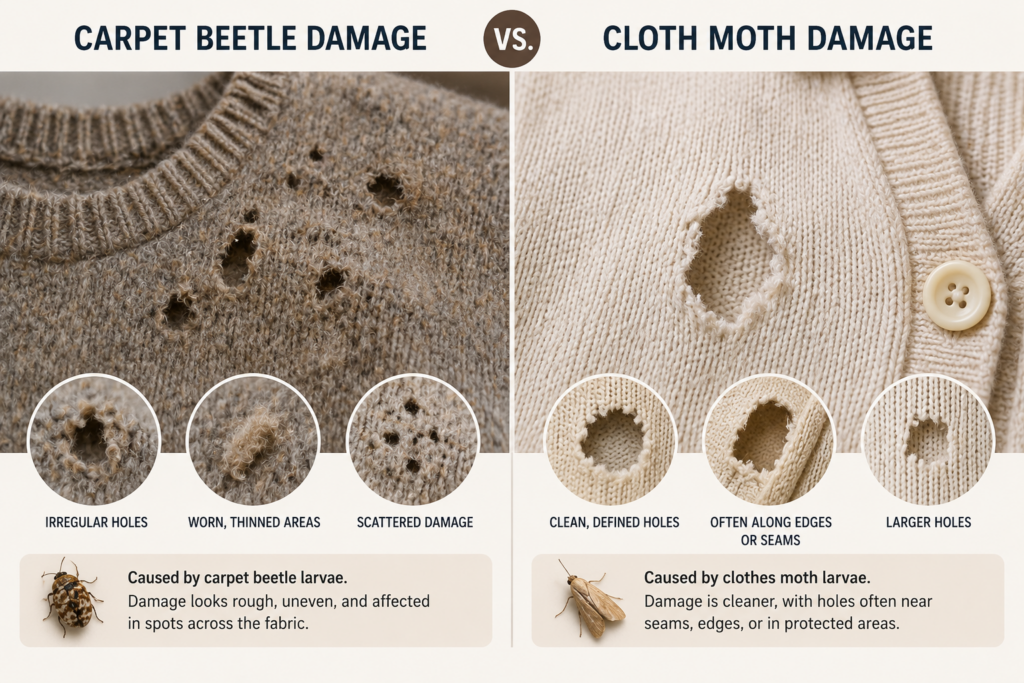
- Case-Making Clothes Moth Larvae: The confusion here stems from the damage they leave behind. If you find a hole in a sweater, you look for a culprit. Because both larvae eat natural fibers, any “worm-like” creature found near a wool suit gets the blame. The key difference is the “sleeping bag”—moth larvae carry a silk case, while carpet beetles are “naked.”
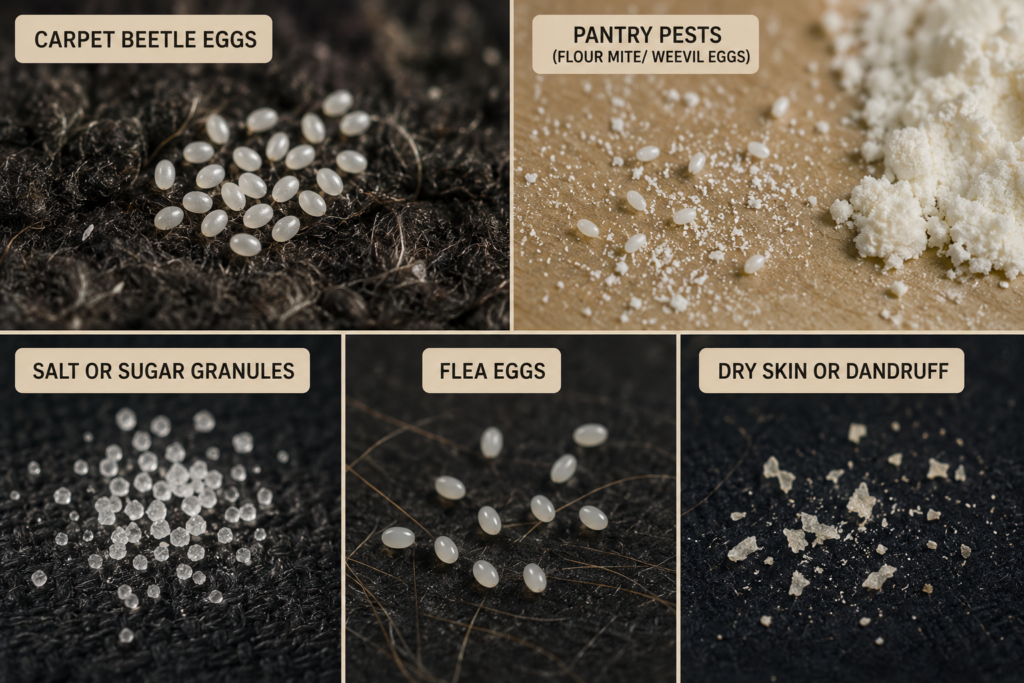
What Can Be Confused With Carpet Beetle Eggs?
Because these eggs are right at the limit of human vision, they are usually “identified” by context rather than detail, leading to frequent errors.
- Pantry Pests (Flour Mite/Weevil Eggs): Confusion occurs because both look like white dust. If you find white specks in a kitchen drawer, it’s hard to know if they are carpet beetle eggs or the result of a grain infestation. The location is the only clue: carpet beetles prefer the “dusty” corners of the drawer, while weevils stay in the flour bag.
- Salt or Sugar Granules: This is a purely visual mix-up. A spilled salt shaker on a dark rug looks exactly like a cluster of carpet beetle eggs. The “why” here is the size and color; both are pearly white and tiny. The only way to tell is to see if they “stick” to the fibers (eggs do) or if they brush away easily (salt does).
- Flea Eggs: These are mistaken for pet activity. If your dog or cat spends time on a specific rug, you expect fleas. When you see tiny white ovals, you assume the worst. The confusion is dangerous because treating for fleas won’t stop a carpet beetle infestation, and vice versa.
- Dry Skin or Dandruff: In a bedroom or closet, dead skin cells accumulate naturally. These white flakes often settle in the same dark crevices where carpet beetles lay eggs. Because they are both small and white, homeowners often over-treat for pests when they really just need a more powerful vacuum for skin debris.
Final Thoughts: What Do Carpet Beetles Look Like?
This article provides the technical blueprint needed to identify carpet beetles at every stage of their development. In the Lower Mainland, where these pests are a constant presence, being able to distinguish the mottled adult beetles from the bristly “woolly bear” larvae and microscopic eggs is the only way to confirm an infestation.
By using the markers detailed here—from the tapered shape of the larvae to the translucent shed skins—you can separate these scavengers from common household look-alikes like bed bugs or simple dust. Recognizing these physical traits enables you to move past the “window watchers” and locate the hidden larval colonies before they cause further damage to your property.
What Do Carpet Beetles Look Like? FAQs
How do I know if the beetle on my window is a carpet beetle?
In Surrey, most “window watchers” are Varied Carpet Beetles. They are roughly 2mm to 3mm long and have a distinct, round, ladybug-like shape. The key marker is their mottled shell, which features a “camo” pattern of white, yellow, and brown scales. If the insect is solid black and more elongated, it is likely a Black Carpet Beetle.
Can I see carpet beetle eggs with the naked eye?
It is extremely difficult. A single egg is less than 1mm long, making it about the size of a grain of salt. While they are pearly white, they are usually tucked deep into the “felt” of air vents or rug fibers. If you see white specks that seem “hooked” into the fabric and don’t brush away easily, those are likely eggs.
What is the easiest way to find the carpet beetle larvae?
Since larvae are photophobic, you won’t find them in the open. You should pull back the edges of area rugs, shine a light into floor registers, or check the dark gaps behind baseboards. Look for a tapered, carrot-shaped insect covered in stiff, reddish-brown bristles.
Are the “hairy bugs” in my drawer larvae or something else?
If they are golden-brown, banded, and have dense tufts of hair, they are carpet beetle larvae. They are often confused with larder beetle larvae, but larder beetles are much larger and have two small “horns” on their rear. If the insect has three long tails and a flat, metallic body, it is a silverfish, not a beetle larva.
What are these translucent, crunchy shells I keep finding?
Those are exuviae, or shed skins. As carpet beetle larvae grow, they outgrow their skins and pop out of them. These hollow, light-brown husks are a 100% confirmation of an active infestation. They often get caught in spider webs or the lint trapped in your heating ducts.
Do carpet beetle larvae move fast?
Yes. Unlike many other household larvae that crawl slowly, carpet beetle larvae scurry quickly when exposed to light. This rapid, darting movement is a defense mechanism to help them find a new dark crevice. If it moves slowly and is carrying a silk tube, it is a clothes moth larva instead.
Why do I have beetles on my window but no holes in my rugs?
The adult beetles feed on pollen and nectar and are trying to get outside. The larvae might be living on “invisible” food sources like accumulated pet hair, dead insects in your wall voids, or the lint trapped inside your floor vents. You may not see damage to your belongings if the colony is thriving on environmental debris.